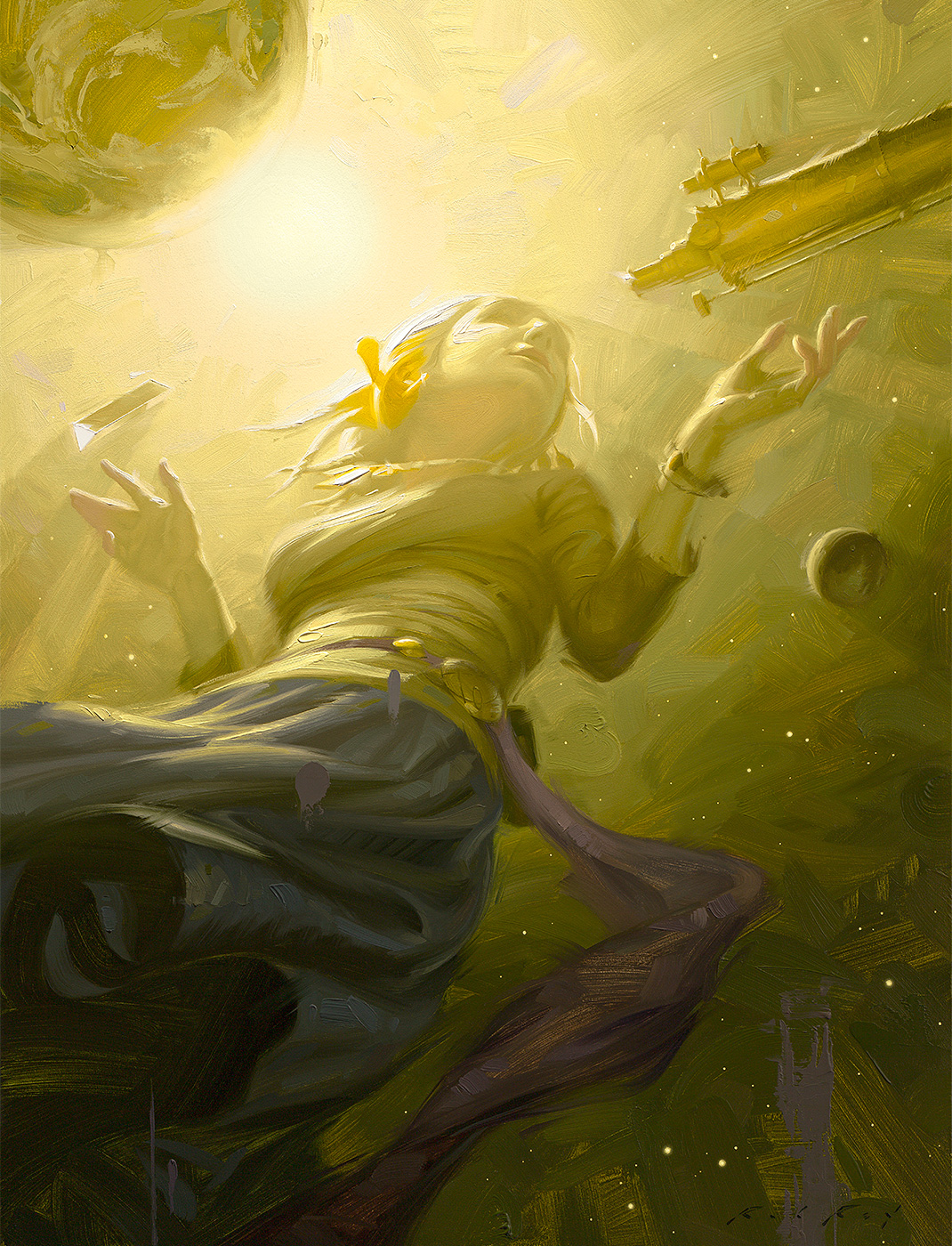
“In a way, it’s really science that’s been inspiring rituals all along. Beneath the specifics of all our beliefs, sacred texts, origin stories, and dogmas, we humans have been celebrating the same two things since the dawn of time: astronomy and biology. The changing of the seasons, the long summer days, the harvest, the endless winter nights, and the blossoming spring are all by-products of how the Earth orbits the sun. The phases of the moon, which have dictated the timing of rituals since the dawn of civilization, are the result of how the moon orbits us. Birth, puberty, reproduction, and death are the biological processes of being human. Throughout the history of our species, these have been the miracles, for lack of a better word, that have given us meaning. They are the real, tangible events upon which countless celebrations have been built, mirroring one another even among societies who had no contact.”
Thursday, April 27, 2023
Moondance
“In a way, it’s really science that’s been inspiring rituals all along. Beneath the specifics of all our beliefs, sacred texts, origin stories, and dogmas, we humans have been celebrating the same two things since the dawn of time: astronomy and biology. The changing of the seasons, the long summer days, the harvest, the endless winter nights, and the blossoming spring are all by-products of how the Earth orbits the sun. The phases of the moon, which have dictated the timing of rituals since the dawn of civilization, are the result of how the moon orbits us. Birth, puberty, reproduction, and death are the biological processes of being human. Throughout the history of our species, these have been the miracles, for lack of a better word, that have given us meaning. They are the real, tangible events upon which countless celebrations have been built, mirroring one another even among societies who had no contact.”
Wednesday, March 8, 2023
Nullius In Verba, Timelapse Video
A new timelapse video of Nullius In Verba is now free to watch on the website!
This video has been available on my Patreon, but I'm now releasing it to the wider public with added vocal narration about the Cosmic Perspective series. So give it a shot with the sound on and let me know what you think!
Latin for "Take nobody's word for it", Nullius in Verba is the motto of the world's oldest national scientific institution, the UK's Royal Society, founded in 1660. The motto was adopted to signify the fellows' determination to establish facts by experiment. They recognized that we cannot accept assumptions or stories from authority, no matter how charismatic. If we want to understand nature, we must observe nature. It has taken centuries to get as far as we have, but this simple idea has allowed humanity to rein in superstition, famine, and disease. It has taken us from horseback to the moon and back. We still face formidable challenges, to be sure, and those challenges make it easy to take for granted just how far we've come. We now communicate at the speed of light, traverse the earth through the sky like birds, and produce more food than we need - even if economic forces keep that food from reaching everyone equitably.
Scientists do get things wrong from time to time and solutions sometimes have unintended consequences, but collective scientific scrutiny of claims leads to a steady correction of errors in our understanding. Science is not perfect, but it is the best method of knowledge discovery we have, and that's worth celebrating.
Original Sold
Prints available
![]() |
| Oil, 24 x 18 inches |
Sunday, February 19, 2023
Great Mystery
- Albert Einstein
Friday, November 18, 2022
Searcher
"The most beautiful experience we can have is the mysterious. It is the fundamental emotion that stands at the cradle of true art and true science. Whoever does not know it and can no longer wonder, no longer marvel, is as good as dead, and his eyes are dimmed. It was the experience of mystery -- even if mixed with fear -- that engendered religion. A knowledge of the existence of something we cannot penetrate, our perceptions of the profoundest reason and the most radiant beauty, which only in their most primitive forms are accessible to our minds: it is this knowledge and this emotion that constitute true religiosity. In this sense, and only this sense, I am a deeply religious man."
- Albert Einstein, The World As I See It
![]() |
| 10 x 8 in Oil on Yupo Panel |
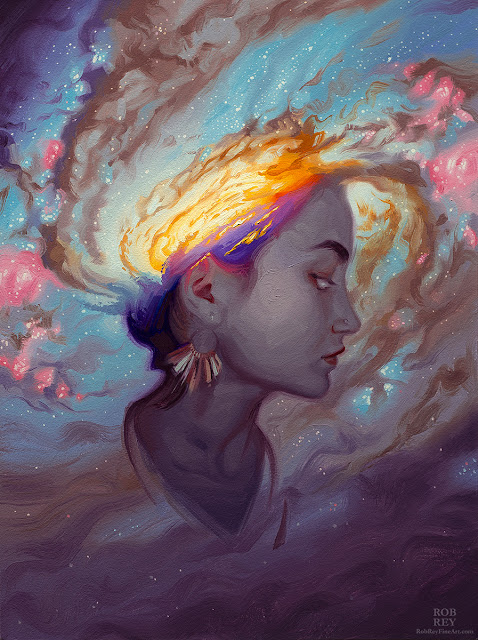
Since I first thought to put a satellite dish in the subjects hair in a painting several years ago, I've enjoyed the rich implied meaning in it. It seems to express a willingness to listen, a curiosity for what's out there. It could imply the search for extraterrestrial life, which in some ways is about finding out who we are. Through listening, it implies humility and a willingness to set aside our desires in favor of observation, so central to science. By pairing it with the Einstein quote above, it becomes about being open to the enchanting mystery of universe and the "spirituality" to be found there. Described well by this quote from Sagan I recently rediscovered:
"Science is not only compatible with spirituality; it is a profound source of spirituality. When we recognize our place in an immensity of light-years and in the passage of ages, when we grasp the intricacy, beauty, and subtlety of life, then that soaring feeling, that sense of elation and humility combined, is surely spiritual. So are our emotions in the presence of great art or music or literature, or acts of exemplary selfless courage such as those of Mohandas Gandhi or Martin Luther King, Jr. The notion that science and spirituality are somehow mutually exclusive does a disservice to both."
Thursday, November 10, 2022
A Galaxy Within II
If you're disappointed by the realization that we are "just" collections of atoms, then you may want to consider more deeply the unfathomable multitude of those atoms, how intricately organized they are to facilitate life, and the oceans of time it took for evolution to shape them into that configuration. The average human body is comprised of more atoms than there are stars, not just in our galaxy, but in the visible universe. These 7 octillion atoms are arrayed in astonishing complexity to create 500 trillion cells of numerous types, each with its own suite of exquisite molecular machines, precisely folded proteins, and ordered genetic code. It's hard to comprehend how long it took for this intricate system to evolve. If that time were the Atlantic ocean at it's narrowest crossing, then all of human history would represent the first 13 feet from the shore. Just to get back to the point where our ancestor was some kind of fish is roughly 185 million generations that had to survive and pass on their genes so that you could experience this world, with all its heartache, and its wonder.
![]() |
| Oil on Panel 24 x 18 inches |
![]() |
| I had a great time, as always, exhibiting at the IX Art Show last month! Photo by Dave Seeley |
Exhibiting at IX always helps to refocus my efforts and clarify my message. The experience of talking about my paintings with one person after another at the show has a way of distilling my thoughts down into their best expressions. What emerged from this years conversations became the second paragraph above. It's a reframing of what is often viewed as a great disappointment when coming to a naturalist world view, that we are "just" atoms. The reality is so staggeringly complex and amazing that I often found myself choking up as tried to convey it.
I am reminded of some wonderful scientific visualizations that have been made of the workings of the human cell. They're a great way to try to wrap your mind around the complexity that is required for us to exist. I highly recommend giving them a few minutes of your time.
Here is a video by Veritasium explaining some amazing cellular animations by Drew Berry.
And here is a short video about the amazing artwork of David Goodwill visualizing the workings of cells and viruses.
Monday, October 17, 2022
Invasion Murals
Wednesday, October 12, 2022
Cosmic Awareness
"We are a way for the cosmos to know itself"
-Carl Sagan
We are products of 13.8 billion years evolution and we are part of this universe, not simply within it.
First, from an incredibly hot and dense beginning, simple atoms of hydrogen and helium had to form as space expanded and cooled. Before a planet could evolve life, these simple atoms had to form stars that would fuse heavier elements. These stars had to burn out in violent explosions that would seed new solar systems like ours with the elements necessary for life. After more than 9 billion years of cosmic evolution, our planet formed and began to evolve life. In this little corner at least, we are the first parts of the universe with the ability to look out at the night sky and understand it. We are the universe coming to know itself.
For me, the meaning of this painting is two fold. There is the meaning expressed above, that we are a part of the universe which has gained consciousness and is experiencing other parts of the universe. But I feel this painting also expresses something about the Cosmic Perspective series more broadly. Having the curiosity to look out and learn about the universe in which we find ourselves is an awakening experience: It's staggeringly vast. Our little sand grain of a planet is the only hospitable place within at least several lightyear's distance. This understanding puts things in perspective, our daily problems seem smaller, our culturally diverse human family feels a little closer, and fighting within it looks even more foolish.
This is what the Cosmic Perspective series in intended to remind us of.
Wednesday, October 5, 2022
Magnetosphere
In addition to the beneficial warmth and light we receive daily, our sun expels a constant wave of dangerous charged particles called the solar wind. When solar storms occur, flares and coronal mass ejections can be thrown our way at speeds of millions of kilometers per hour. Luckily, movements within earths molten metal core generate a protective magnetic shield around our home planet. Without our magnetosphere to protect us, the solar wind may have long ago stripped away our atmosphere, leaving Earth looking much more like Mars looks today: barren, dry, and lifeless.
Most of us don’t spend much time thinking about our magnetosphere, but it’s one of the many extraordinary things that make life possible on our little world.
![]() |
| Oil, 30 x 24 in |
Friday, August 19, 2022
Complexity Rising, Study
Before there could be cells, there needed to be complex molecules and a host of elements to make them. The earliest known events of the universe generated only a few of the lightest elements: hydrogen, helium, and a little bit of lithium. Until the first stars formed and began fusing protons and neutrons into larger nuclei, the universe was devoid of heavier elements, including the carbon, nitrogen, and oxygen of which we are made. Other processes took these elements and bonded them into basic amino acids and other molecular precursors to life as we know it.
Biological evolution on our planet is thought to be nearly as old as the Earth, but the complexity that made it possible has been accumulating since time began.
Thursday, May 19, 2022
Magnetosphere Study
In addition to the beneficial warmth and light we receive daily, our sun expels a constant wave of dangerous charged particles called the solar wind. When solar storms occur, flares and coronal mass ejections can be thrown our way at speeds of millions of kilometers per hour. Luckily, movements within earths molten metal core generate a protective magnetic shield around our home planet. Without our magnetosphere to protect us, the solar wind may have long ago stripped away Earth’s atmosphere, leaving Earth looking much more like Mars looks today: barren, dry, and lifeless.
Most of us don’t spend much time thinking about our magnetosphere, but it’s one of the many extraordinary things that make life possible on our little world.
![]() |
| Detailed Study, Oil, 8 x 6 inches |
Thursday, April 14, 2022
First Magic: the Gathering Card Illustration
My first Magic: the Gathering card illustration was recently revealed. This image is for their new set "The Streets of New Capenna" which takes place in a 1920's themed fantasy world.
For those who might be interested in purchasing the original art, the auction is live in the MtG Art Market Facebook group until Wednesday, April 19th, 11pm Eastern time.
![]() |
| Mari, the Killing Quill Oil on panel, 18 x 24 inches |
Friday, February 18, 2022
A Galaxy Within II, Study
We are each a little galaxy of our own. It's a mind-bending exercise trying to comprehend the 100 billion stars found in a typical galaxy. Yet, each of us has roughly the same number of neurons in our own brain, performing a symphony of consciousness. Similar too, is the number of atoms that write out our DNA code. We are a staggeringly complex and unique collection of natural components, come together for a short, precious moment.
Large numbers are difficult to fathom, but to be disappointed in the realization that we are “just” collections of atoms moving in accordance with the laws of physics, is to misunderstand the depth of this astonishing complexity, and the billions of years it took to evolve.
“We are the miracle, we human beings. Not a break-the-laws-of-physics kind of miracle; a miracle in that it is wondrous and amazing how such complex, aware, creative, caring creatures could have arisen in perfect accordance with those laws [of nature] … Our emergence has brought meaning and mattering into the world ... It bequeaths to us the responsibility and opportunity to make life into what we would have it be.”
-Sean Carroll, The Big Picture
| Oil on Panel, 8 x 6 inches |
Monday, December 6, 2021
Holiday Small Works
Three new small works appearing in Abend Gallery's 31st Annual Holiday Minitaures Show, now live online!
Taking the opportunity to experiment a little, I painted these three works on Yupo paper, a smooth plastic sheet, which I mounted to panel. The slick surface allows the paint to slide around more, making it easier to get some really interesting fluid marks.
I feel like these pieces convey the sense of an active universe, in which dust clouds are currently swirly and condensing into new stars!
![]() |
| Steadfast 5 x 7 inches, Oil on Yupo Panel |
![]() |
| Jovian Night 8 x 10 inches, Oil on Yupo Panel |
![]() |
| Flow 8 x 6 inches, Oil on Yupo Panel |
Thursday, November 11, 2021
Inertia Timelapse Video
Watch me paint the face of Inertia in just over a minute! Well, it was actually about three hours of painting time, but you can watch the whole thing in about a minute. This video has been available to Patreon subscribers for a while now. A new video of Nullius In Verba is now available over there if you want become a subscriber and check it out.
Objects orbiting the Earth are in constant, weightless free fall. They are just traveling fast enough that by the time they would have fallen to the ground they have passed, or missed the earth, only to find themselves on another side of the planet falling still.
In order to miss the earth's surface from the altitude of low earth orbit, the International Space Station, for instance, must travel an amazing 4.76 miles per second (7.6 km/s).
Saturday, September 18, 2021
Song of the Universe, Study
The other voice incants, “Everything matters!” We are here, now, wrapped in the real experience of our joy and suffering, enmeshed in a web of relations with all life on earth. Everything that we do has consequences that will be experienced by our fellow beings. There is profound purpose to be pursued in the improvement of life for ourselves and others. A melody of unity and goodwill.
Different though they seem, each voice tempers the other and blends in a bittersweet, harmonized hymn: a song of Cosmic Perspective.